01 / FRAME
What Is Frame for Men?
Before you even say a word,
everyone in the room has already formed
an impression of you.
Before your voice, your clothes or even your posture,
one of the first things people notice is your
frame.
Your frame is your overall physical structure —
the combination of your height, shoulder width
and bone structure.
Have you ever wondered why some people instantly
strike you as powerful or imposing?
The answer often lies in their frame.
Greater height and broader shoulders can create
a silhouette that projects physical dominance
and produces a stronger visual presence.
How We Read Physical Presence
The human mind is capable of evaluating another
person's physical capabilities within seconds.
Research suggests that even a photograph or
silhouette can provide enough information for
surprisingly accurate estimates of a man's
physical strength.
Research in evolutionary psychology and
anthropology traces this form of rapid assessment
back to survival pressures faced by our ancestors.
In prehistoric environments, a person's physical
frame was more than an element of appearance.
It could act as an early signal of another
individual's potential strength, threat level
and physical capability.
Threat, Safety & Physical Presence
When our ancestors encountered another individual
or group, visible signs of physical superiority —
such as greater height and a larger upper body —
could provide useful information when assessing
the risks involved in a possible confrontation.
Modern life is very different, but the human brain
still processes physical cues extremely quickly.
The impression that someone looks stronger,
more dominant or more imposing is often not the
result of conscious calculation.
That impression can form within seconds.
The Shoulder-to-Hip Ratio
(SHR) Effect
The width of the upper body relative to the hips,
commonly described as the
shoulder-to-hip ratio (SHR),
plays an important role in how male body
proportions are perceived.
A broader upper torso combined with a narrower
waist and hip line is often associated with
masculinity, physical fitness and perceived
dominance.
When broad shoulders are combined with greater
height, the result can be a larger, stronger and
more visually dominant silhouette.
That sense of strength and imposing presence we
experience when looking at someone today may be
an echo of millions of years of evolutionary
history — the ancient language of survival,
still speaking to us.
Why Shoulder Width Matters
Shoulder width has a major influence on the
appearance of the upper body.
Wider shoulders can make the torso look broader,
increase the visual contrast between the upper body
and waist, and create a stronger physical presence.
However, shoulder width is not determined by
muscle alone.
The underlying skeletal structure provides the
foundation on which the visible shoulder shape
is built.
CLAVICLE & SHOULDER STRUCTURE
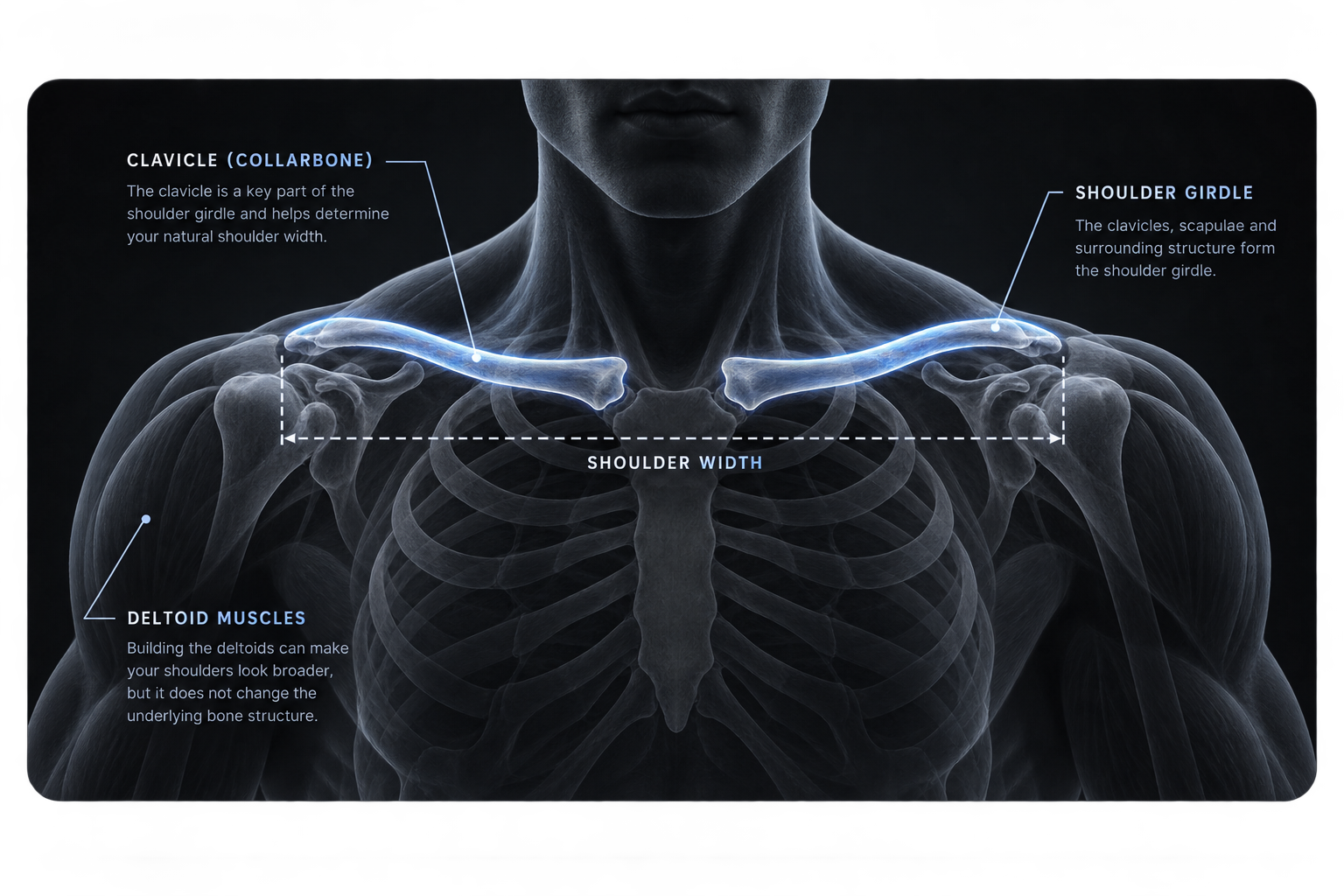
The Role of the Clavicle
The clavicles, or collarbones,
form an important part of the shoulder girdle
and contribute to the natural width of the
upper body.
Longer clavicles and a naturally broader
shoulder girdle can create a wider skeletal base
before muscle mass is even considered.
This structural base helps determine how broad
the shoulders can appear relative to the rest
of the body.
Genetics Sets the Foundation
Bone length, clavicle structure, shoulder-girdle
proportions and overall skeletal dimensions are
strongly influenced by genetics.
Training can develop the deltoids, upper back
and surrounding musculature, making the shoulders
appear broader and more powerful.
However, muscle growth builds on top of the
existing skeletal frame — it does not completely
change the underlying bone structure.
Muscle can enhance the frame.
Genetics helps define the base it is built on.
02 / MOGGING
What Is Mogging?
Mogging is an internet term used when one person
appears noticeably more physically impressive than
another person in a direct comparison.
On FrameMog, the term is used specifically to
describe differences in
physical frame.
This includes characteristics such as height,
shoulder width, skeletal proportions and overall
body structure.
What Does Mogging Mean?
In simple terms, someone may be described as
“mogging” another person when their physical
characteristics appear clearly stronger, larger
or more noticeable by comparison.
The term can be used online for many different
characteristics, including height, physique,
facial appearance, style or overall attractiveness.
FrameMog, however, uses a much narrower definition.
On this website, mogging is focused mainly on the
structural characteristics of the body.
Facial features, hairstyle, clothing and other
appearance factors are not included in the main
scoring system.
Frame Comes First
Two people can have similar levels of muscle mass
or similar levels of body fat while still looking
very different because of their skeletal
proportions.
A taller person or someone with broader shoulders
may appear physically larger even before
differences in muscle mass are considered.
This is why FrameMog focuses primarily on
structural characteristics rather than attempting
to evaluate a person's entire appearance.
Why Height Matters
Height changes the overall scale of the body.
A taller person naturally occupies more vertical
space and may appear physically larger when
standing next to someone shorter.
Height alone, however, does not define a person's
frame.
Shoulder width and overall body proportions also
matter.
Why Shoulder Width Matters
Shoulder width has a strong effect on the
appearance of the upper body.
Wider shoulders generally make the torso appear
broader and can create a stronger visual presence.
The same shoulder width can also look very
different depending on height.
A measurement that appears exceptionally broad on
a shorter person may appear much more average on
someone significantly taller.
For this reason, FrameMog does not treat shoulder
width as completely independent from height.
Mogging Is a Comparison
Mogging is not an absolute measurement.
It describes a comparison between people.
For example, one person may have shoulders that
are broader than average but still appear smaller
next to someone who is both taller and
significantly broader.
This is why FrameMog considers several physical
measurements together instead of relying on only
one number.
What FrameMog Does Not Measure
FrameMog does not attempt to measure a person's
value, personality, intelligence, social status
or real-world physical ability.
The scoring system is designed only to compare
selected physical measurements in a simple and
entertaining way.
The Idea Behind FrameMog
FrameMog takes measurements such as
height and shoulder width
and converts them into a simple scoring system.
The goal is to give users an approximate idea of
how their physical structure compares with general
reference values.
In short, mogging on FrameMog simply means having
a noticeably stronger physical frame in a
comparison.
It is not a scientific judgment about a person
as a whole.